
Direct Answer for Search & AI Overview:
A truly effective hair-care routine should not be complicated—it must simply address two distinct biological zones: your scalp (living skin requiring hygiene and oil balance) and your hair lengths (non-living keratin fiber requiring lubrication, moisture retention, and friction protection). A complete everyday routine consists of five simple steps: (1) Scalp-tailored cleansing, (2) Cuticle conditioning on mid-lengths and ends, (3) Targeted leave-in treatment or serum when appropriate, (4) Protection against heat and mechanical friction, and (5) Periodic routine calibration.
Why Your Hair Routine Should Match Your Hair and Scalp Needs
In modern cosmetic trichology, the golden rule of hair care is simple: Wash your scalp, condition your hair lengths.
Many people struggle with their hair because they treat their head as a single uniform surface. In reality, your scalp and your hair lengths have opposite biological characteristics:
- Your Scalp is Living Skin: It produces sebum, sheds dead epidermal cells, sweats, and has a dynamic microbiome. It requires thorough, regular cleansing to prevent scalp buildup and maintain follicular health.
- Your Hair Fiber is Non-Living Keratin: Once hair emerges from the follicle pore, it is non-living tissue. It cannot repair itself from within or generate its own moisture. It requires external conditioning emollients, cuticle smoothing, and protection against mechanical friction and heat.
A successful routine matches your shampoo to your scalp's oil level and your conditioner to your hair strand's level of dryness or damage.
Step 1: Understand Your Scalp Type
Before picking products, determine your scalp's oil production and comfort level:
- Oily Scalp: Roots look shiny, flat, or greasy within 24 hours of washing. Hair requires frequent cleansing to maintain volume. (Read: Why Does My Hair Get Oily So Fast?).
- Balanced / Normal Scalp: Hair feels comfortable for 2 to 3 days after washing without excessive greasiness, itching, or dryness.
- Dry Scalp: Scalp feels tight, taut, or slightly itchy within hours of washing. Flakes, if present, are small, white, and dry.
- Buildup-Prone Scalp: Regular use of styling creams or dry shampoo creates a waxy film that gathers under nails when scratched. (Read: Scalp Buildup Causes & How to Remove It).
- Flaky / Dandruff-Prone Scalp: Frequent yellowish, oily flakes accompanied by persistent itching and scalp irritation.
Step 2: Understand Your Hair Needs
Next, assess the condition of your hair lengths and ends:
- Dryness & Porosity: Does hair feel rough and straw-like even after conditioning? (Read: Why Is My Hair Still Dry After Using Conditioner?).
- Mechanical or Heat Damage: Are there visible split ends, flyaways, or snapping strands from flat-ironing or blow-drying?
- Weakness and Thinning: Does hair feel fragile, with noticeable shedding during brushing?
- Frizz and Manageability: Do humidity and static cause hair to puff up uncontrollably?
The Foundational 5-Step Hair-Care Blueprint
Regardless of hair type, every healthy hair routine is built on five core pillars:
Step 1: Scalp Cleansing (Shampoo)
Use a sulfate-free shampoo formulated with botanical surfactants. Wet hair thoroughly with lukewarm water, lather the shampoo in your hands, and focus application strictly on the scalp. Massage with your finger pads for 60 to 90 seconds. Let the lather rinse down the lengths without aggressively scrubbing the ends.
Step 2: Cuticle Conditioning (Conditioner)
Gently squeeze excess water from your hair lengths. Apply conditioner from mid-lengths to ends, detangling gently with your fingers or a wide-tooth comb. Allow 2 to 3 minutes for conditioning agents to bind to the hair cuticle before rinsing cleanly with cool water.
Step 3: Targeted Scalp or Strand Treatment (Serum)
On towel-damp or dry hair, apply targeted treatments. For scalp stimulation and root nourishment, apply a leave-in treatment like Rosemary Hair Serum. (Learn how it compares to water in Rosemary Water vs Rosemary Serum).
Step 4: Protection (Heat & Friction)
If blow-drying or heat styling, always apply a heat protectant. Avoid aggressive towel-rubbing—use a gentle microfiber wrap instead.
Step 5: Periodic Adjustment
Calibrate your routine based on seasons and activities. Use an active clarifying wash or deep conditioning mask once every 1 to 2 weeks as needed.
Customized Routines by Hair and Scalp Type
1. Routine for Oily Scalp
- Goal: Remove excess surface sebum without triggering rebound oiliness.
- Cleanser: Cutenessence Rosemary Shampoo (Wash 2–3 times weekly, double cleansing on primary wash days).
- Conditioner: Cutenessence Rosemary Conditioner applied strictly from mid-lengths to ends.
- Targeted Care: 4 to 6 drops of Rosemary Hair Serum applied to clean scalp at night.
- Guide Reference: Explore our deep dive on Why Does My Hair Get Oily So Fast?.
2. Routine for Dry or Heat-Damaged Hair
- Goal: Smooth rough cuticles, seal in cortex moisture, and reduce brushing breakage.
- Cleanser: Cutenessence Damage Repair Shampoo with plant keratin and argan oil.
- Conditioner: Cutenessence Damage Repair Conditioner left on damp ends for 3 to 5 minutes.
- Guide Reference: Review Why Is My Hair Still Dry After Using Conditioner?.
3. Routine for Weak, Brittle, or Hard-to-Manage Hair
- Goal: Strengthen fragile strands against snap breakage and improve overall softness.
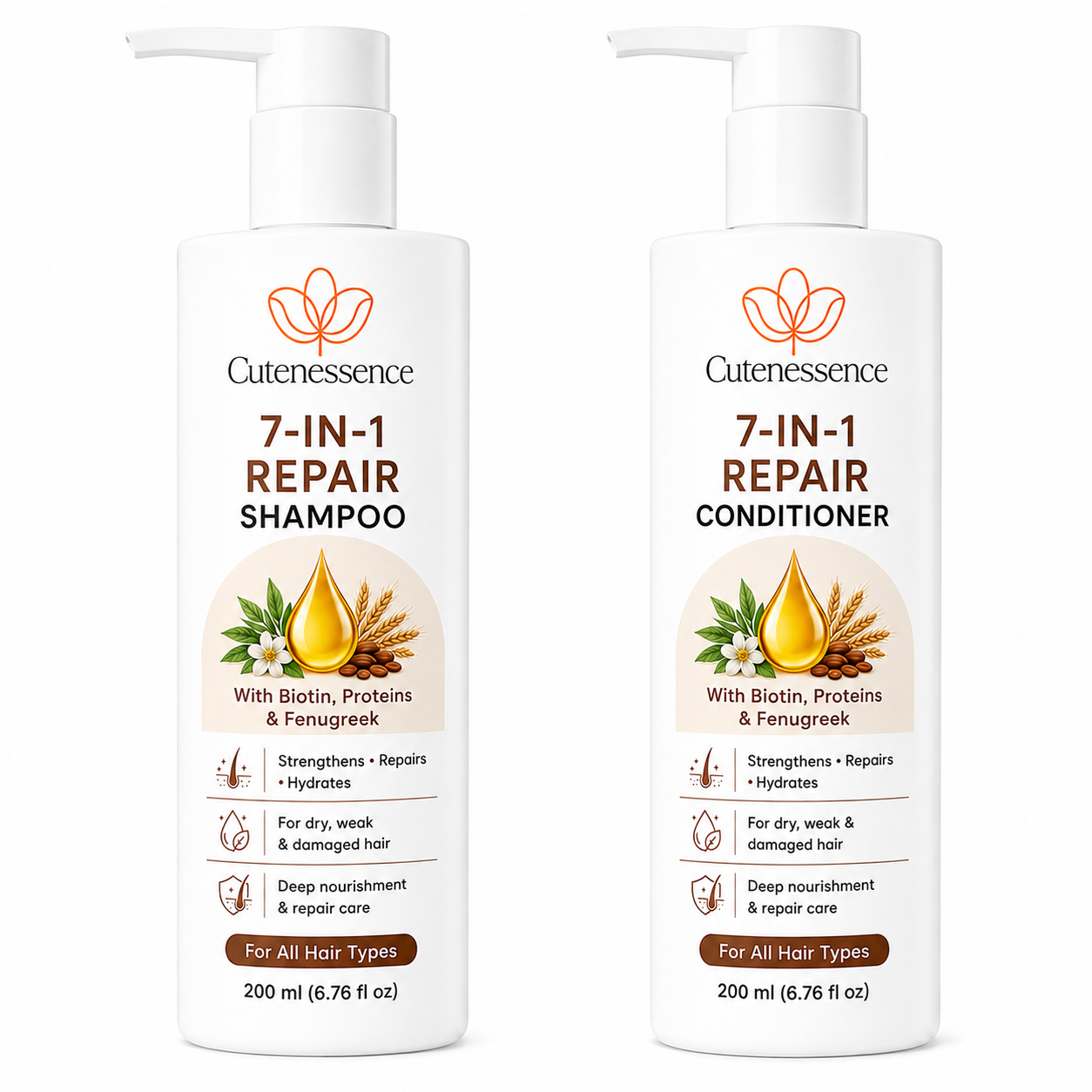
- Cleanser: Cutenessence 7 in 1 Repair Shampoo enriched with Biotin, Plant Proteins, and Fenugreek.
- Conditioner: Cutenessence 7 in 1 Repair Conditioner to detangle and seal hair fibers.
4. Routine for People Interested in Rice Water Haircare
- Goal: Enhance natural shine, volume, and elasticity with fermented rice water proteins and inositol.
- Cleanser: Cutenessence Rice Water Shampoo.
- Conditioner: Cutenessence Rice Water Conditioner.
- Realistic Formulation Note: Fermented rice water provides excellent cosmetic amino acids that coat and smooth hair fibers. However, claims that rice water "grows hair overnight" are folklore myths; its true benefit lies in strand resilience and reduced breakage.
5. Routine for Flaky or Dandruff-Prone Scalp
- Goal: Purify scalp flaking, soothe itchiness, and balance the scalp microbiome.
- Cleanser: Cutenessence Anti-Dandruff Shampoo with Tea Tree and purifying actives.
- Conditioner: Cutenessence Anti-Dandruff Conditioner on hair lengths.
- Guide Reference: Learn to differentiate flakes in Scalp Buildup vs Dandruff: What's the Difference?.
How Often Should You Wash and Condition Your Hair?
| Scalp Profile | Wash Cadence | Conditioning Rule |
|---|---|---|
| Oily Scalp / Active Sweating | Every 1 to 2 days | Always condition mid-lengths to ends |
| Normal / Balanced Scalp | 2 to 3 times weekly | Every single wash day |
| Dry or Chemically Treated Hair | 1 to 2 times weekly | Generous conditioning + periodic deep masking |
| Fine Hair Prone to Limpness | Every 2 days | Lightweight conditioner; avoid root contact |
| Dandruff-Prone Scalp | 2 to 3 times weekly | Active clarifying wash + light lengths conditioning |
5 Common Hair-Care Mistakes
- Washing with boiling hot water: Hot water strips natural lipids from both scalp and hair cuticles, exacerbating dryness and triggering oily rebound.
- Piling hair on top of the head while shampooing: Scrubbing hair lengths in a tangled ball causes intense friction and cuticle breakage. Let lengths hang naturally and cleanse the scalp.
- Applying conditioner directly to roots: Adds unneeded grease and clogs follicle openings with heavy emollients.
- Brushing wet hair without slip: Hair is at its most fragile when wet. Always detangle gently with a wide-tooth comb while conditioner is in hair or after applying a leave-in.
- Switching routines every week: Hair takes at least 4 to 8 weeks to respond visibly to a new regimen. Consistency is essential.
How to Keep Your Routine Simple
You do not need a bathroom cabinet filled with a dozen products. A consistent, high-performing haircare routine requires only three core essentials:
- A gentle, sulfate-free Shampoo matched to your scalp.
- A nourishing, cuticle-sealing Conditioner matched to your lengths.
- An optional targeted Leave-in Treatment (such as Rosemary Hair Serum) for specific scalp or strand goals.
Focus on proper technique, consistent wash intervals, and quality botanical actives.
Frequently Asked Questions
Surface smoothness, detangling ease, and shine improve with your very first wash. Deeper benefits—such as reduced strand breakage, improved manageability, and balanced scalp oiliness—typically become visible within 4 to 8 weeks of consistent routine care.
Yes! If you have an oily scalp with dry, heat-damaged ends, you can wash your scalp with Rosemary Shampoo and condition your ends with Damage Repair Conditioner. Tailoring products to your specific scalp and strand needs is often the most effective approach.
Not always. A single wash is sufficient if you wash your hair daily or have minimal styling product buildup. Double cleansing is most helpful if you wash every 2 to 3 days, use styling products, or have exercised heavily.
Take a single strand of clean wet hair and stretch it gently. If it stretches a little and returns to its original length, balance is healthy. If it stretches endlessly without bouncing back and feels gummy, it needs protein. If it snaps immediately with zero stretch, it is dry and thirsty for moisturizing emollients.
If you experience sudden patchy hair thinning, extreme scalp tenderness, persistent thick scaling, or redness that does not respond to standard cosmetic care, consult a board-certified dermatologist for professional clinical assessment.


